Reef Tank Lighting Explained: PAR, Spectrum, and Photoperiod for Coral Growth
Lighting is the single most argued-about piece of equipment in this hobby, and for good reason: it’s the one variable that determines whether your corals thrive, bleach, or just quietly decline for six months while you troubleshoot everything else. Salinity, temperature, and flow all matter, but light is the actual food source for the photosynthetic algae (zooxanthellae) living inside most SPS, LPS, and soft coral tissue. Get it wrong and no amount of dosing or flow tuning will fix it. This guide walks through the numbers that actually matter — PAR, spectrum, and photoperiod — along with how to acclimate corals to new light and where to place different coral types in your tank.
What PAR Actually Means (and Why Lumens Don’t Matter)
PAR stands for Photosynthetically Active Radiation. It’s a measurement of the number of photons landing on a surface per second, within the 400–700nm wavelength range that drives photosynthesis, expressed as micromoles per square meter per second (μmol/m²/s). This is the number you should care about — not wattage, not lumens, and not “watts per gallon,” all of which are either irrelevant to reef tanks or leftover advice from freshwater planted tank forums.
Lumens measure brightness as perceived by the human eye, which is weighted heavily toward green and yellow light and essentially ignores the blue and red wavelengths corals rely on most. A fixture can have an impressive lumen rating and still deliver mediocre PAR to your coral, because lumens simply aren’t measuring the same thing. If you want to know what light is actually reaching your coral, you need a PAR meter (a handheld quantum meter like an Apogee MQ-510, or a hobbyist option like the Seneye or PAR-based apps paired with a calibrated sensor) or you rely on published PAR charts from the manufacturer for your fixture at your specific height and intensity setting.
Rough PAR targets by coral type, measured at the coral’s actual position in the tank (not at the water surface):
- Soft corals and mushrooms: 50–100 PAR
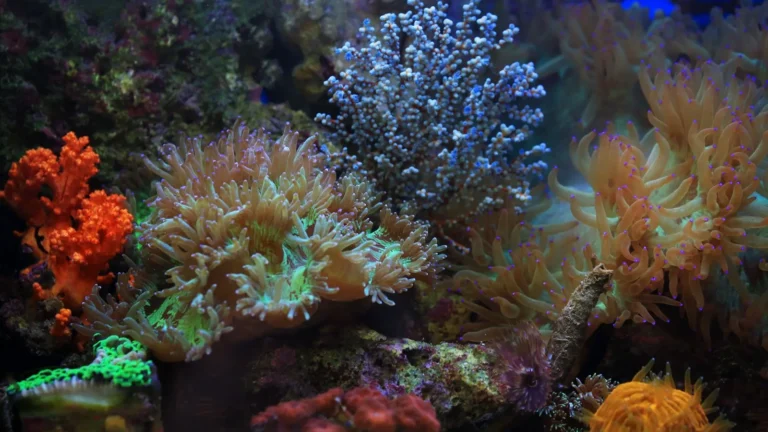
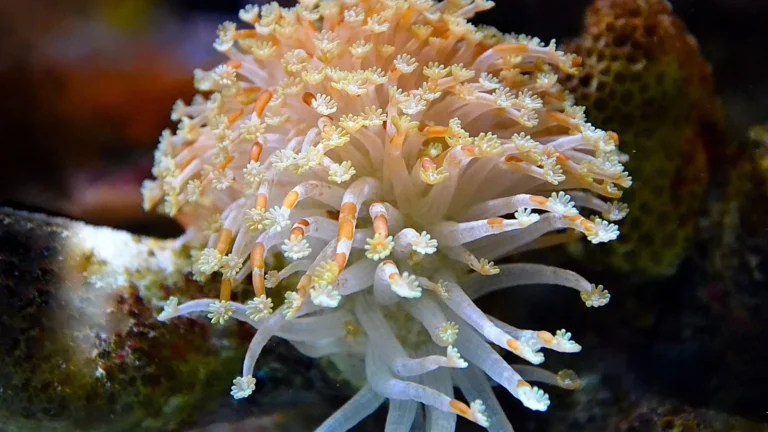
- LPS (torch, hammer, frogspawn, acans, chalices): 75–150 PAR
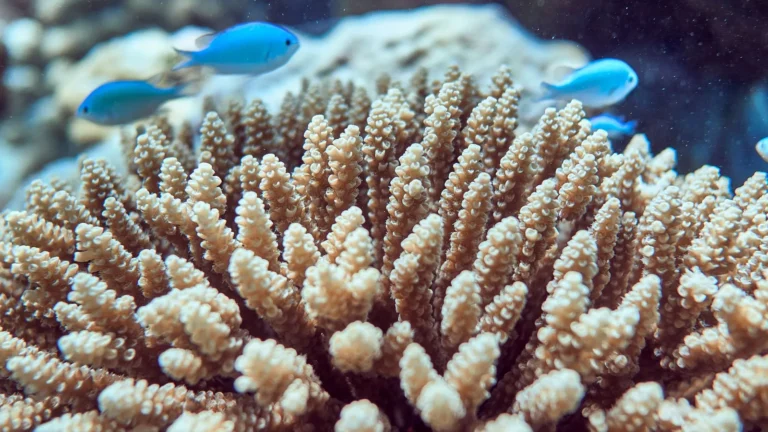
- SPS (Acropora, Montipora, Pocillopora): 200–400+ PAR
- Clams (Tridacna): 150–350 PAR depending on species
These are starting ranges, not hard limits — plenty of SPS colonies thrive at 250 PAR under stable conditions, while others are pushed to 500+ under intense metal halide-style LED setups. What matters more than hitting a specific number is consistency and proper acclimation to whatever intensity you land on.
Spectrum: Why Corals Need More Than Just Blue Light
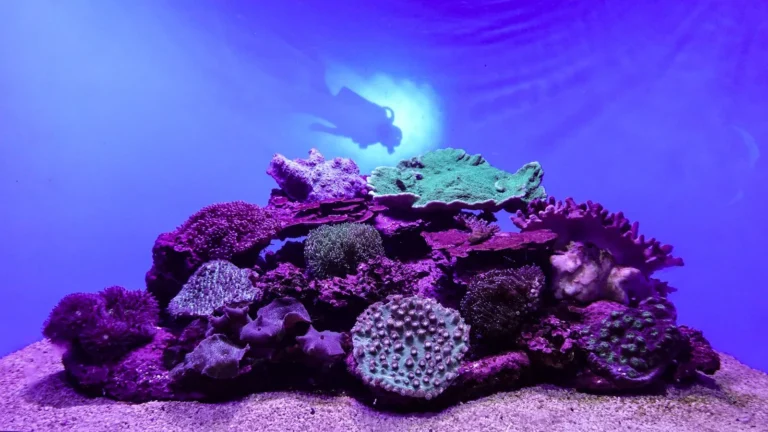
Reef tank lighting culture has a well-earned obsession with blue light, and there’s real science behind it — zooxanthellae’s chlorophyll a and c, along with peridinin, absorb strongly in the 400–480nm blue range, and blue light penetrates seawater far deeper than red, which is why deep reef corals evolved to depend on it. But a tank that’s 100% blue with no other wavelengths isn’t optimal — it’s just aesthetically popular because it makes fluorescent pigments pop.
A well-balanced reef spectrum typically includes:
- Royal blue (450nm) and blue (460–470nm): the core photosynthetic driver and the wavelength that triggers the most vivid coral fluorescence
- Violet (400–420nm): supports certain pigment proteins and adds depth to fluorescent colors
- Cyan (490–520nm): fills a gap many all-blue setups miss and helps with overall coral health and pigmentation
- A small amount of white/full-spectrum light (550–700nm): improves how the tank looks to the human eye and provides some red wavelengths that specific pigments use
Most modern LED fixtures let you dial in a channel mix, and manufacturers publish suggested starting presets — use them as a baseline, not gospel. A common, safe starting mix for a mixed reef is roughly 70–80% blue/royal blue channels, 10–15% white, and the remainder split between UV/violet and green/cyan if your fixture offers them. If your corals look washed out or brown rather than vividly colored, you likely need more intensity or a longer acclimation period before touching spectrum — don’t chase color with spectrum changes as a first move.
Photoperiod: How Long to Run Your Lights
Photoperiod is simply how many hours per day your lights are on, and it interacts directly with intensity — a tank running high PAR for 10 hours delivers a very different total light dose than one running the same PAR for 6 hours. Most established reef tanks run an 8–10 hour total photoperiod, often structured as a ramp rather than an on/off switch:
- Ramp-up (30–60 min): lights gradually increase from low intensity to full
- Peak period (4–6 hours): full intensity, sometimes with a “blue peak” window at the midpoint where actinic channels run slightly higher
- Ramp-down (30–60 min): mirrors the ramp-up in reverse
- Extended blue/moonlight channels (optional): low-intensity blue or lunar LEDs for a couple of hours before and after the main period, mostly for viewing enjoyment and to let nocturnal inverts feel comfortable
Running lights longer than about 10–12 hours total, or running high intensity for extended periods, is one of the more common causes of nuisance algae blooms — cyanobacteria and film algae both use available light just as readily as your coral does. If you’re fighting algae and your nutrients are otherwise in range, cutting photoperiod by an hour or two before touching anything else is often the fastest fix. Resist the urge to run lights 12+ hours “to grow corals faster” — it doesn’t work that way, and it usually backfires.
Acclimating Corals to New Light
Coral photosynthetic tissue can genuinely sunburn, and it happens more often than people expect — usually after buying a coral from a dim frag tank at a local fish store and dropping it straight under a high-output LED at home, or after upgrading fixtures without ramping intensity slowly. The result is bleaching (loss of zooxanthellae, tissue turning pale or white) that can take weeks to recover from, if the coral survives at all.
A safe acclimation protocol:
- New coral purchases: place in the lowest-light zone of the tank (bottom, in shade of rockwork, or under a floating acclimation box) for the first 3–5 days, then move it up incrementally every few days over 2–3 weeks toward its target zone.
- New fixture installs or upgrades: start all channels at 40–50% of target intensity and increase by roughly 5–10% every few days over 3–4 weeks rather than jumping to full power on day one.
- Watch for stress signs: tissue paling, excessive mucus production, polyp retraction that doesn’t resolve within a day, or bleached patches on the sun-facing side of the colony. Any of these mean back off intensity immediately and slow the ramp.
The most common mistake is impatience — hobbyists see a coral looking fine after three days at full intensity and assume it’s acclimated, when photo-oxidative stress can take a week or more to visibly show. Slower is always safer here; there’s no clock you’re racing against.
LED vs T5: What’s Actually Different
This debate has mostly settled in the LED direction over the past decade, but T5 fluorescent still has legitimate use cases, and understanding the actual tradeoffs matters more than picking a side.
LED advantages: significantly better energy efficiency, no bulb replacement schedule (though LEDs do degrade slowly over years and lose intensity), programmable spectrum and photoperiod, lower heat output into the room, and the ability to hit very high PAR in a compact footprint for deep or high-demand SPS tanks.
T5 advantages: extremely even, diffuse light spread with minimal shadowing or “disco ball” shimmer effects, a spectrum that many hobbyists find renders coral color more naturally straight out of the bulb, and a more forgiving intensity curve that makes overdriving a coral to the point of burn less common. T5 bulbs do need replacement roughly every 9–12 months as output drops, even though they may still look bright to the eye.
Many experienced reefers run a hybrid: an LED fixture supplemented with one or two T5 bulbs (often actinic or a coral-plus spectrum) to soften LED shadowing and add spectral fill. If you’re starting from scratch on a budget, a quality LED fixture with a proper controller and published PAR chart is the more practical modern choice for most tank sizes.
Placement by Coral Type
Even with a great fixture, coral placement inside the tank is what actually determines the light each individual coral receives — PAR drops off substantially with depth in the water column, and shading from other corals or rockwork compounds this.
- Top of the rockwork / high flow zones: SPS (Acropora, Montipora digitata, Seriatopora), which want both high PAR and strong flow to keep their tissue clean and gas-exchanging efficiently.
- Mid-tank, moderate flow: most LPS (hammers, torches, frogspawn, acans, favias) and many Montipora capricornis plating corals, which prefer indirect or gently diffused light rather than direct high-intensity blast.
- Sand bed and lower rockwork, low-to-moderate flow: soft corals like zoanthids, mushrooms, and leathers, along with many clam species that don’t need the ceiling-level intensity SPS demands. Note that some soft corals like Sinularia and Sarcophyton actually tolerate and even prefer higher light than their reputation suggests — check species-specific needs rather than assuming “soft coral” always means low light.
- Deep crevices and cave structures: non-photosynthetic corals (many gorgonians, sun corals/Tubastraea, chili corals) that rely entirely on target feeding rather than light and should be kept out of intense zones where they gain nothing and may even be stressed by the heat and intensity.
When in doubt about a specific coral’s needs, research the species rather than the broad category — a green star polyp and a purple gorgonian octocoral both get called “soft coral” colloquially, but one wants strong light and the other wants none at all.
Putting It Together
There’s no universal “correct” PAR number, spectrum recipe, or photoperiod length that works for every tank — what matters is picking reasonable starting values, measuring what your fixture actually delivers rather than trusting the box, acclimating slowly whenever something changes, and adjusting placement based on how individual corals respond rather than by rulebook alone. A fixture with a published PAR chart, a controller that lets you ramp intensity and photoperiod, and the patience to make changes gradually will get you further than chasing the newest high-wattage LED release. Watch your corals, not just your settings — they’ll tell you when something’s off long before a test kit will.
Related reading
- Reef Aquarium Lighting 101: PAR, Spectrum, and Coral Growth
- Aquascaping a Reef Tank: Stability, Flow, and Coral Real Estate
- Common New-Tank Mistakes That Crash a Reef Cycle
- Budgeting a Reef Tank: True Cost of the First Year
Sources & further reading
Helpful Gear for This Project
The gear links below go to Amazon; as an Associate, this site earns from qualifying purchases.
- Compare LED reef lighting fixtures on Amazon — Photoperiod and spectrum are what actually drive coral color and growth
- Check out coral frag tools and dip — Good frag tools and a proper coral dip protect the rest of your tank